
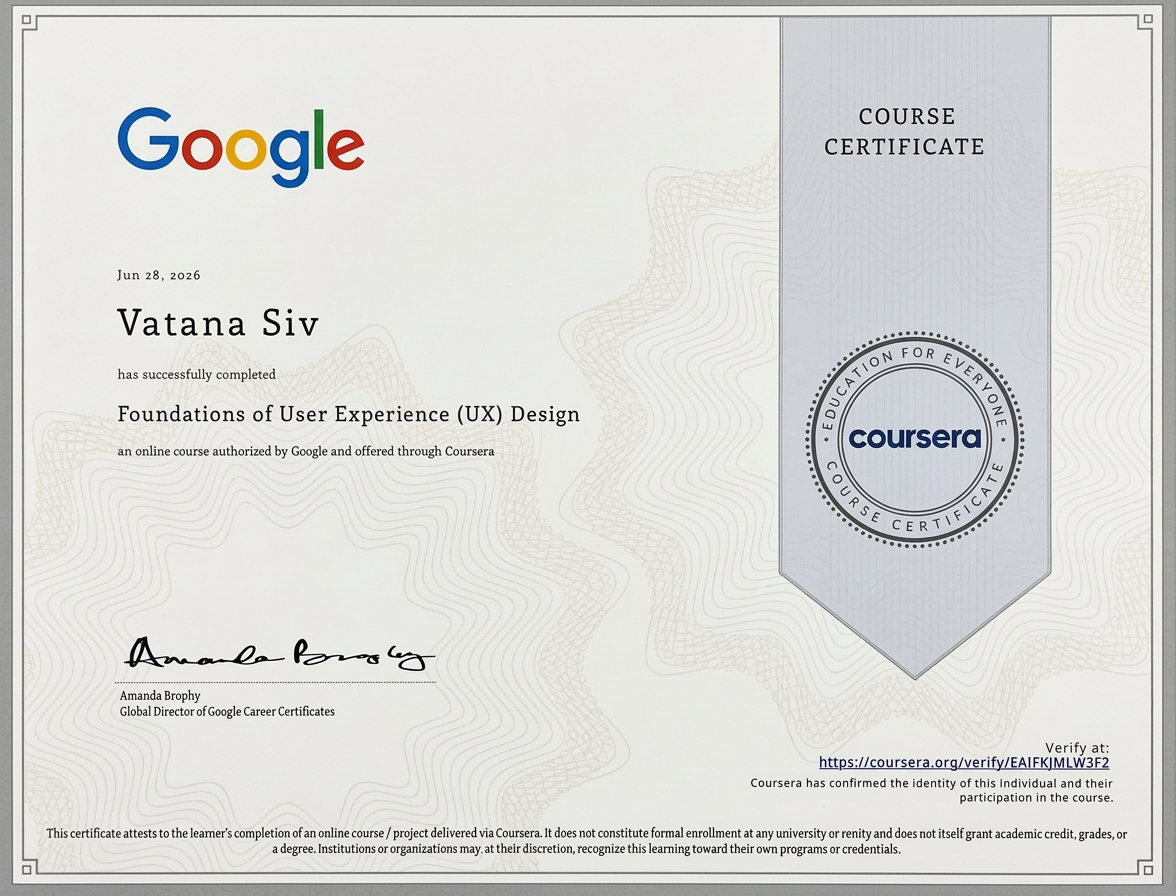
I recently completed Foundations of User Experience (UX) Design, part of the Google UX Design Certificate on Coursera.
I expected to come away with a new vocabulary—wireframes, prototypes, user journeys, design thinking. What I didn’t expect was for one concept, equity-focused design, to make me stop and look back at work I had already done.
It felt strangely familiar.
Not because I had formally studied equity-focused design before, but because I recognised some of the questions in work I had been doing for years.
A concept that named what I already knew
My work sits at the intersection of civil society, data, and content — managing research and publishing platforms, producing bilingual content, and building tools meant to make information more open and accessible.
In that work, “the user” was never really an abstraction.
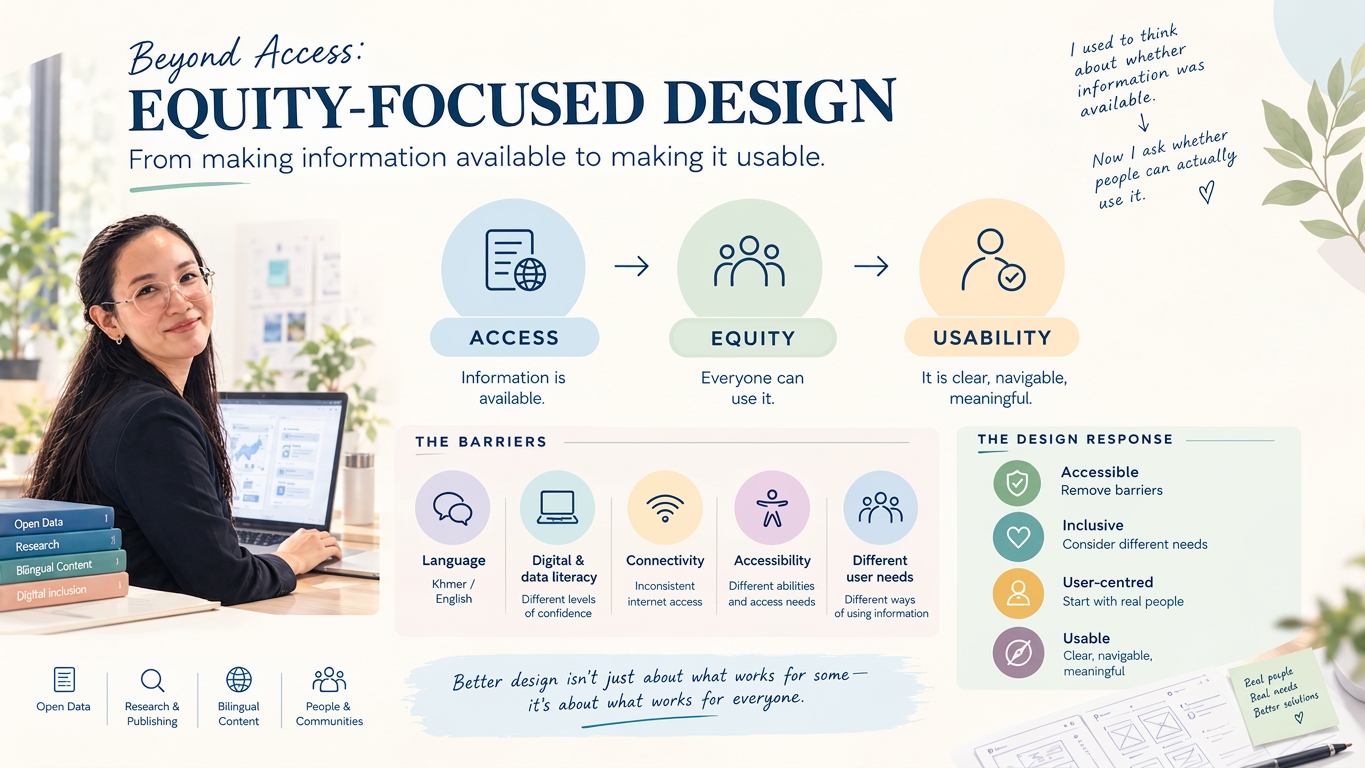
It was someone with limited internet access, limited digital literacy, or limited data literacy, trying to find information that was rarely built with their reality in mind.
That’s why equity-focused design landed so differently for me.
It wasn’t a completely new idea I had to learn from scratch. It gave me language for something I had sensed through experience: making information available is not the same as making it usable.
I had spent years helping put information online. But the course made me ask a slightly uncomfortable question:
What happens after someone reaches the platform?
Can they find what they need?
Do they understand what they are looking at?
Do they know what to do next?
And what if the platform itself assumes a level of digital or data literacy that they don’t have?
Those questions felt obvious once I started asking them. I’m not sure why I hadn’t been asking them in quite the same way before.
Design as a bridge, not just a craft
Perhaps that’s the shift this course gave me.
I started seeing UX design less as a discipline concerned mainly with how something looks or functions, and more as another way of thinking about the gap between a system and the people expected to use it.
My first training was in engineering, where I learned to think about systems, constraints, and how things are built to function. Years later, working with open data taught me to think about access to information—who has it, who doesn’t, and what information can make possible.
UX is making me pay closer attention to what happens in between:
What does a person actually experience when they encounter the system I helped build?
That question feels relevant far beyond websites or applications.
Recognising my own work in the framework
This is where the course’s core principles — user-centred design, accessibility, and design thinking — stopped feeling like industry jargon and started feeling like a description of decisions I’d already been making instinctively, without a name for them.
When I led the launch of a knowledge-sharing platform for civil society organisations, I was already thinking about who might struggle to use it — people with limited digital literacy, people more comfortable in Khmer than English, people with inconsistent internet access.
I made choices around those realities.
But I was doing it mostly through experience and instinct, rather than through a deliberate design process.
I was reacting to barriers as I noticed them.
The course made me realise that there is a difference between noticing a barrier and designing for it from the beginning.
That distinction has stayed with me.
It made me look differently at some of the platforms and content I had worked on—open data tools, learning portals, bilingual resources—and wonder where I had designed around people’s realities, and where I had simply made something available and hoped they could navigate the rest themselves.
What “access” missed in my own work
Looking back, I can see how much of my work treated digital transformation as an access problem:
Get the platform online.
Get the content published.
Get the data open.
And that mattered.
But access was never the whole story.
I’ve seen how someone can reach a platform and still not really be able to use it because the way it is structured assumes a level of digital or data literacy they don’t have.
That’s not necessarily a connectivity problem.
Sometimes it is a design problem.
And I didn’t have the framework to fully see that distinction until now.
For platforms like the ones I work on—intended to open information and knowledge sharing to civil society—the goal therefore cannot stop at putting content online.
The content has to be findable.
Understandable.
Navigable.
And meaningful to the people it is meant to serve.
That sounds obvious as I write it now. But sometimes we only recognise the obvious after experience gives us a reason to look again.
What I want to notice differently
This course didn’t give me a brand-new mission.
It changed what I notice.
I’ve spent years working on platforms meant to make information and knowledge more open. What I’m taking from this course is a more deliberate way to think about the people on the other side of those platforms.
Not just:
Can they access it?
But:
Can they use it?
And perhaps even more importantly:
Were they considered when we designed it?
That’s the shift I want to carry into future work—to apply equity-focused, user-centred thinking from the beginning, rather than waiting for barriers to appear and then trying to respond to them.
I don’t think this course changed what I care about.
It gave me a better way to see it.
And maybe that’s what learning is sometimes supposed to do—not give us an entirely new way of working, but give us the language to understand our own work more clearly.
I used to think more about whether people could reach the information.
Now I’m thinking more about what happens once they get there.

